Web development choices can determine whether a local business website generates relevant inquiries or attracts visitors who are unlikely to become customers. For service businesses targeting Seattle, Tacoma, Bellevue, Renton, and nearby areas, a polished appearance is only part of the job. The website also needs to explain the service, confirm where it is available, build trust, and provide a clear path to contact.
At ITishniki, we look at websites from a business-first angle. Website design, web development, hosting, SEO, testing, and content structure all work together. When one part is weak, local leads can drop in quality before the business even sees the inquiry.
How Web Development Improves Lead Quality
Strong web development choices that shape how local leads move through a site help a website guide the right visitors from search to action. Lead quality improves when visitors can confirm that the company provides the required service in their area before submitting an inquiry. Clear pages, accessible navigation, reliable functionality, and a usable mobile layout matter more than decorative features that do not support that decision.
For local businesses, the best site usually answers three questions quickly:
- What service does the company provide?
- Where does the company work?
- How can the visitor request help?
If users have to search too hard, the site may still get traffic, but the leads may be weaker.
How Website Design and UI Design Support Local Leads
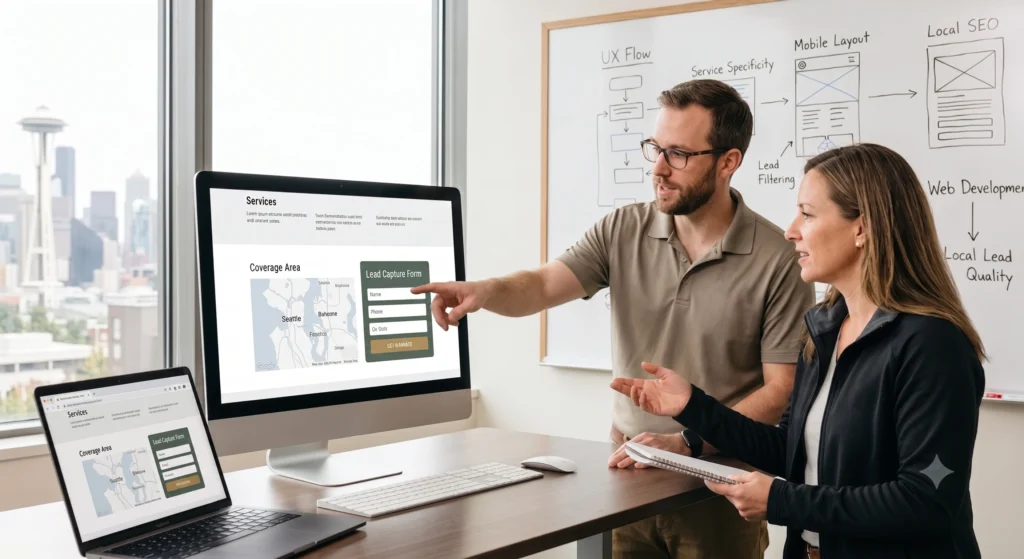
Website design affects how quickly visitors can decide whether a business is relevant to their needs. Clear visual hierarchy should lead them from the service description to coverage details, supporting information, and the appropriate contact option without forcing them to search across several pages. Designers should organize written service information, coverage details, and contact options across web pages so they follow a clear decision path. Visual balance prevents overwhelming users and improves content scanning.
Visual trust also depends on functional consistency. Service information, buttons, forms, and mobile layouts should support the same user path. Using reusable components ensures a predictable and reliable user experience. A polished page cannot compensate for unclear service details or a contact process that creates unnecessary friction.
Website Area | Effect on Local Inquiries |
Navigation | Connects visitors with the relevant service and contact path |
Mobile layout | Reduces friction when users browse, call, or submit a form by phone |
Contact forms | Collects the information needed to understand and route an inquiry |
Page structure | Clarifies the service, coverage area, and next step |
Testing | Identifies broken forms, links, layouts, and tracking before launch |
How Web Developers Use Front End Decisions to Reduce Inquiry Friction
Before a team begins to build websites, it needs accurate business resources, including service definitions, coverage details, approved content, brand assets, and contact-routing requirements. Those resources help the team develop a new site around real customer questions. Goal-oriented purpose ensures the website serves both user needs and business goals. The goal is to create websites that help visitors determine whether the service matches their needs.
Website developers and front-end developers influence more than the appearance of the finished site. Web development includes front-end and back-end coding. Front-end developers focus on user interface design and usability. Back-end developers handle server-side logic and database management. HTML defines the content structure, CSS controls its presentation, and JavaScript supports interactive elements such as menus and forms. Well-structured HTML also keeps headings, links, fields, and buttons logically organized across web pages.
Why Website Developers Need Practical Testing Skills
Technical knowledge and practical development skills matter when they support a reliable inquiry path. Completing a course or following a software engineer career path does not by itself show whether a developer can create an effective local business website. For example, developers should explore what happens when a required field is missed, a script fails, or a form returns an error. MDN’s guidance on client-side form validation explains how required fields and input formats can be checked before data reaches the server. Browser-testing tools, accessibility tools, form-validation tools, and analytics tools can help identify these problems before launch. This practical testing is more relevant to lead quality than adding features without a clear business purpose.
For a local business, the relevant question is not which programming languages were used. It is whether the finished website helps suitable visitors reach the correct service page, confirm local availability, and complete an inquiry without technical friction.
How Responsive Web Design Improves the Mobile User Experience
Responsive web design is essential for service companies. Many users look for help from mobile devices, especially when they need a contractor, repair provider, marketing partner, or local service quickly. The W3C guidance on minimum target size explains that controls should have sufficient size or spacing to make them easier to activate. If a button is hard to tap, a form is too long, or text is difficult to read, users may leave before they ever contact the business.
A local service website should allow mobile visitors to:
- read service information without zooming;
- confirm that their location is covered;
- reach core services without navigating through unnecessary pages;
- tap phone and contact buttons reliably;
- complete a form with only the information needed for the inquiry;
- understand what will happen after submitting the form.
Hosting, SEO, and Pre-Launch Checks Also Affect Leads
A site can look complete and still perform poorly after launch. That is why hosting setup that supports a small business website after launch matters because a small business website must remain accessible after launch. Functional websites must load quickly to provide a positive user experience. If pages become unavailable or forms do not function reliably, the business may lose inquiries without immediately knowing why. Hosting decisions should therefore support consistent access to service pages, forms, and contact options.
Before launch, pre-launch website checks that help protect lead quality are also important. Each form should be submitted and verified from the visitor’s action through to its intended destination. Links, mobile layouts, contact buttons, page access, analytics events, and confirmation messages also need to be checked so that the team can identify both failed submissions and gaps in tracking.
SEO should connect the right visitors with the right pages. SEO work that helps the right local visitors find the website supports traffic quality by aligning keywords, service pages, content, and technical structure.
Local Website Decisions That Usually Matter Most
A Seattle-area small business website should help visitors determine whether the company matches their service, location, and project needs before they make contact. This requires more than adding city names to otherwise generic pages.
The most useful decisions include:
- assigning a clear search intent to each service page;
- explaining the service scope without forcing visitors to infer what is available;
- displaying relevant coverage information where users need it;
- keeping unrelated offers off focused landing pages;
- asking only for information the business can use to evaluate or route an inquiry;
- connecting SEO targets with the page’s actual content and conversion path.
These decisions cannot guarantee that every inquiry will be qualified, but they can reduce ambiguity before the visitor contacts the business.
FAQ
What web development choices affect lead quality most?
Navigation, mobile layout, contact forms, page structure, speed, testing, and service-page clarity all affect whether suitable visitors can find the right service and complete an inquiry.
Is website design different from web development?
Yes. Website design generally focuses on layout, visuals, and user experience, while web development turns those decisions into functioning code, structure, and features.
Why do local businesses need responsive web design?
Local visitors often browse from mobile devices. If the site is hard to use on a phone, users may leave before calling or submitting a form.
Do small business websites need SEO during development?
Yes. SEO is easier to support when structure, headings, links, page content, and technical setup are considered before the site launches.
How can a website reduce irrelevant local inquiries?
Service pages should clearly explain what the business provides, where the service is available, and which contact path visitors should use. Forms can also request the minimum information needed to identify the required service and location before the inquiry reaches the business.

Ник Курков — владелец iТишники
6 лет опыта в разработке веб-сайтов и улучшении SEO для компаний, добившихся значительного роста.