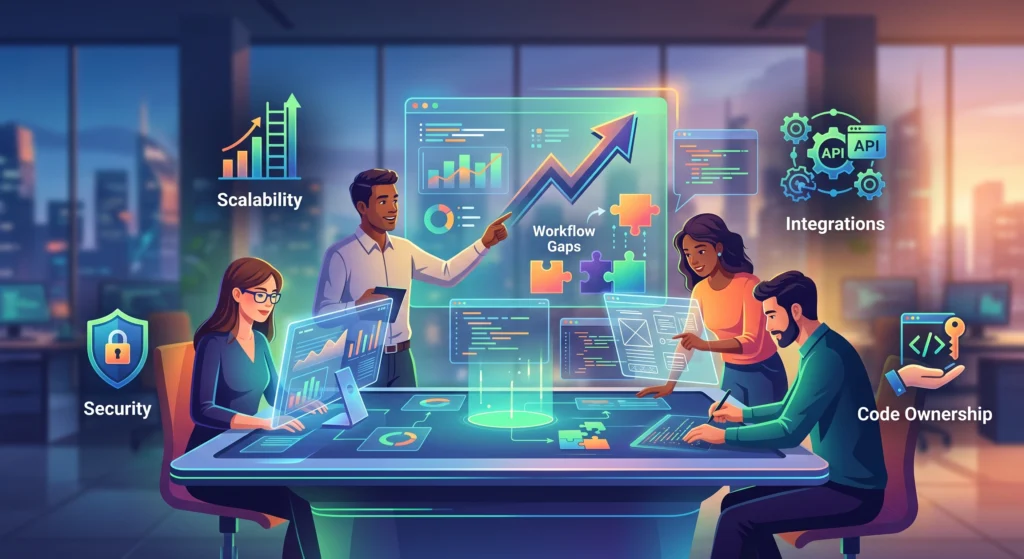
Custom software development makes sense for a growing business when standard tools can no longer support its workflows without repeated manual work, costly workarounds, disconnected data, or rising licensing costs. It is the right choice when a defined operational problem cannot be solved efficiently by adapting or integrating existing software and the expected value justifies development, testing, deployment, and maintenance.
As a company grows, employees may spend more time transferring data, correcting errors, or navigating software that no longer matches established processes. Customers can also encounter inconsistent experiences when information and services are divided between disconnected systems.
When Custom Software Becomes a Business Need
Custom software becomes worth considering when a company has unique workflows that cannot be managed effectively with standard tools. The clearest warning sign is often operational friction: employees repeat the same tasks, information must be entered into multiple systems, or important data remains scattered across departments.
For a business evaluating web development services for growing businesses, the first step should be identifying the specific process that needs improvement. A new web app should solve a defined business problem rather than simply add another platform for employees and customers to manage.
Common signs that custom software development may be appropriate include:
- Existing apps require too many workarounds.
- Employees rely on spreadsheets to connect separate processes.
- Current software cannot support new features or integrations.
- Users need centralized access to data and business tools.
- Licensing fees continue to increase as the company adds users.
- Security requirements are more specific than a standard product can accommodate.
- The company needs greater control over its software and source code.
A growing business may not need to replace every current system. In some cases, custom software can connect the existing software ecosystem and provide one user-friendly interface for the most important operations.
Where Custom Software Development Services Create Practical Value
Custom software development services are most valuable when they address a process that directly affects productivity, customer service, or access to actionable insights. The software should reflect how the business actually operates instead of forcing its teams to adapt every process to a generic product.
Web Applications and a Purpose-Built Web App
A browser-based application can give employees, clients, or customers centralized access to tools and data through web browsers on multiple platforms and devices. A purpose-built web app may combine business logic, a database, and a user interface around one defined workflow, such as managing customer requests, internal tasks, accounting workflows, retail inventory, or support activities.
The exact features should follow confirmed user requirements rather than assumptions. By bringing relevant information and actions into one system, the application may reduce duplicate work and the time employees spend switching between separate tools.
Not every business needs complex web-based applications. If a company only requires a fast, distinctive website, custom-coded web solutions may be more appropriate than full application development. The choice depends on whether users need to view content or interact with business processes.
Software Solutions for Integration and Automated Workflows
Integration is one of the strongest reasons to consider custom software. A company may already have useful tools, but those tools may not exchange data efficiently. Custom software solutions can be designed to connect the current software ecosystem and align it with the organization’s established processes.
This alignment can support automated workflows for repetitive tasks. It may also reduce duplicate data entry and give users more consistent access to information. The objective is not automation for its own sake. Each automated step should remove a specific bottleneck or improve the reliability of a process.
Custom software development services can also help companies create solutions around unusual requests or industry-specific operations. For example, custom Shopify store development may be relevant when a standard e-commerce setup covers only part of a retailer’s required workflow.
Cloud Infrastructure, Analytics, and AI Features
Technology choices should follow the approved requirements. Planning the next generation of a system does not mean adding cloud infrastructure, analytics, or AI features by default. Each feature should support a defined workflow, data requirement, or measurable objective. When AI is part of the project scope, the NIST AI Risk Management Framework provides a structured approach to identifying and managing its risks.
Adding technology without a clear use case increases project scope, development costs, and maintenance requirements. The development team should therefore explain how each proposed feature supports the business problem the software is intended to solve.
What a Custom Software Development Company Should Cover
A reliable custom software development company should follow a structured lifecycle that includes discovery, design, development, testing, and deployment. This development process helps connect the final software to the company’s specific needs.
Requirements Gathering, System Architecture, and Programming Languages
Requirements gathering establishes what the software must do, who will use it, and which existing systems it must support. As Digital.gov explains, user research helps teams understand users’ needs and behaviors before they develop a product or service. This stage should clarify necessary features, user roles, data access, integration requirements, and expected processes.
The development team can then plan the system architecture and select suitable programming languages, database tools, and server requirements. For browser-based projects, these technologies may include JavaScript for interactive behavior and cascading style sheets for layout and presentation. The team should develop the system against the approved requirements rather than allowing a preferred technology to dictate the business solution.
Clear requirements gathering also helps control scope creep. New features and change requests can be evaluated against the original project goals instead of being added without considering their effect on development and deployment.
User Interface, Quality Assurance, and Deployment
The user interface determines how employees or customers interact with web applications. Even technically capable software can create more work if users cannot understand the interface or complete tasks efficiently.
Claims that a product is “top notch” do not demonstrate software quality. Quality assurance should examine whether the system functions as intended and whether users can complete the required processes. Testing may also reveal performance problems, security concerns, and bug fixes that need to be addressed before deployment.
The development process does not necessarily end when the software is released. Maintenance and support may be needed as the business adds users, changes operations, receives new requests, or introduces additional features. These responsibilities should be clarified with the developers before the project begins.
How Custom Software Can Support Digital Transformation
Custom software can drive digital transformation only when it improves a defined process. Replacing spreadsheets or disconnected tools with a more complicated system does not create value by itself.
A purpose-built solution can be planned for additional users, integrations, and features, but scalability should be treated as a defined requirement rather than a general promise. Its financial case must account for development, testing, deployment, maintenance, infrastructure, and future changes—not only potential licensing savings.
How to Evaluate Software Development Before Committing
The decision should begin with the business problem, not the code. Before selecting custom software development services, define the workflow that needs attention and identify why existing solutions cannot support it adequately.
Ask the following questions:
- Which processes are creating the greatest operational friction?
- Who will use the software, and what access will each type of user need?
- Can an existing product solve the problem without extensive customization?
- Which apps, tools, or databases must the new system connect to?
- What data and regulatory compliance requirements apply?
- Which features are essential for the first deployment?
- How will performance, security, and quality assurance be evaluated?
- Who will manage maintenance, support, and future bug fixes?
- Does the agreement provide the business with ownership of the source code?
- Does the development partner have the required expertise and fit?
Careful partner selection is part of the development process. A custom software development company should be able to explain how discovery, development, testing, and deployment connect to the client’s requirements.
Some businesses may also need website design and development services alongside application development. The distinction matters: a website primarily presents information, while web applications allow users to interact with data, tools, and processes. A project may involve one or both.
FAQ About Custom Software Development
Is custom software development only for large companies?
No. A growing business may benefit when unique workflows, complex integrations, or limitations in standard software begin to reduce efficiency. The decision should depend on the business need rather than company size alone.
When should a business choose a web app?
A web app may be appropriate when users need browser-based access to shared data, tools, or processes. Web applications can be particularly useful when teams or customers need access across multiple operating systems.
Can custom software integrate with existing tools?
Yes. Improved integration with the current software ecosystem is one of the principal reasons organizations select custom software. The required integrations should be identified during requirements gathering.
Does custom software provide better security?
Not automatically. Custom software can address company-specific access, data, and integration requirements, but its security depends on architecture, development practices, testing, deployment, updates, incident response, and ongoing maintenance.
Can custom software reduce costs?
Custom software reduces ongoing licensing fees and often improves long-term value. The business should still compare those potential savings with development, deployment, cloud services, support, and maintenance requirements.
Who owns the custom software code?
Custom software provides businesses with complete ownership of the source code. This ownership should still be confirmed in the development agreement, which must define repository access, usage rights, third-party components, documentation, and responsibility for future maintenance.
How do businesses avoid scope creep?
Define essential features during requirements gathering and evaluate later requests against the approved project goals. This keeps the software development process focused on the problem the system was created to solve.

Ник Курков — владелец iТишники
6 лет опыта в разработке веб-сайтов и улучшении SEO для компаний, добившихся значительного роста.